Who we are
Pages in this section
Pages in this section
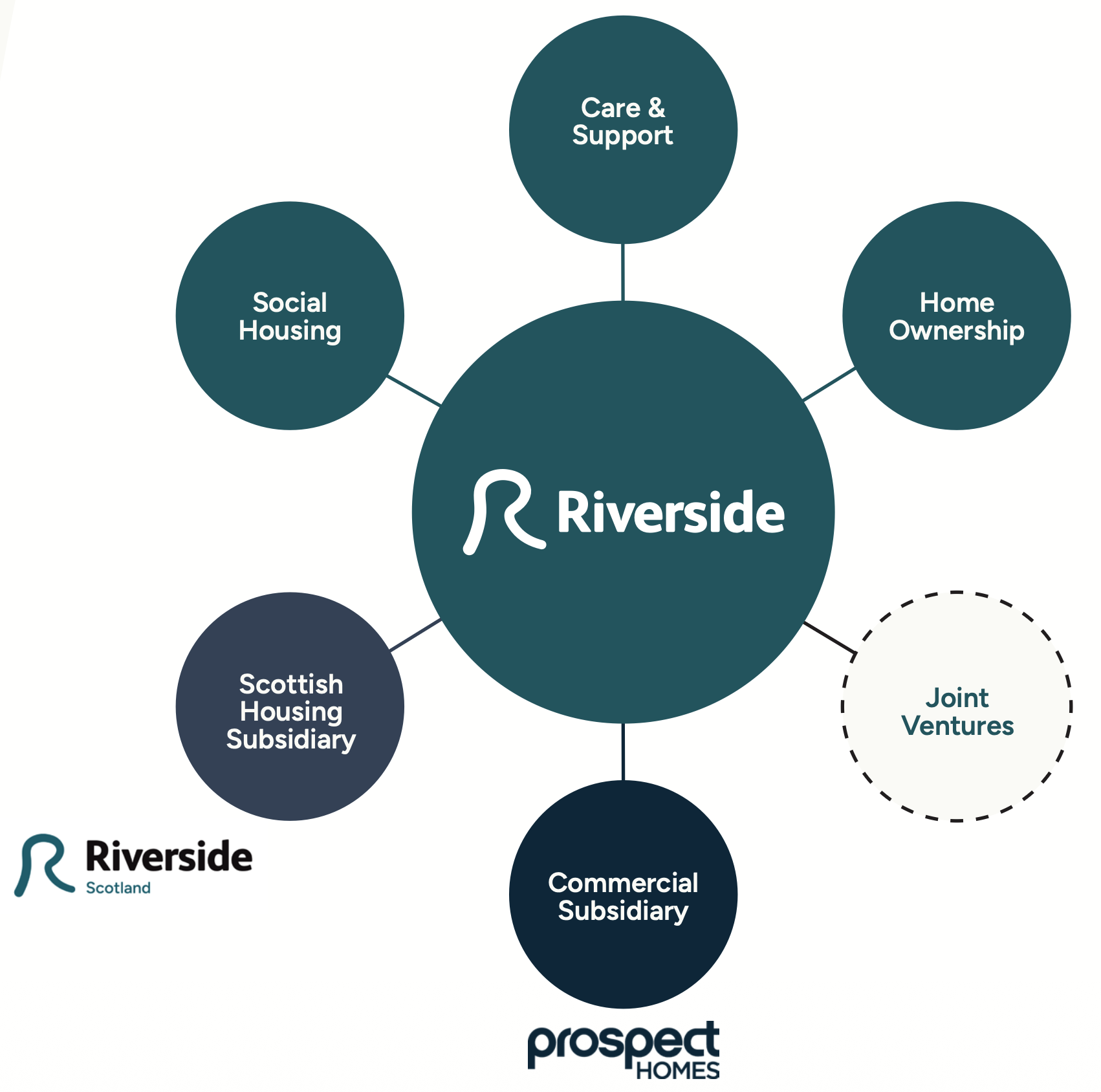
We provide:
2025/26 Highlights*
Pages in this section
*Figures correct as at end of March 2026.
**This figure is based on our Statistical Data Return submitted to the Regulator of Social Housing for England, it does not include homes owned and/or managed by Riverside Scotland. The figure includes: general needs, intermediate, affordable, supported/ housing for older people and low-cost home ownership.
Foreword - Paul Dolan and Cris McGuinness
At Riverside, our social purpose continues to guide every decision we make. We believe providing safe, affordable, and sustainable homes is fundamental to helping people and communities thrive, and we remain committed to delivering long-term value for our customers, colleagues, investors, and wider stakeholders.
Over the past year, we have continued to invest in our homes, neighbourhoods, and services, while strengthening the foundations that support our environmental, social, and governance ambitions. During 2025/26, Riverside has focused on improving the quality and energy efficiency of our homes and have continued to develop this approach through the creation of a strategic, costed retrofit roadmap. We are enhancing customer services through our comprehensive Customer Influence and Accountability Framework, enabling customers to influence decisions, scrutinise performance, challenge service delivery and hold management to account at local, operational, strategic and governance levels. We continue to deliver targeted support to our customers, helping individuals build resilience and independence across so many of our areas of work through our Foundation-funded projects. These priorities remain central to our Brighter Future Together corporate plan and our commitment to creating positive social impact on a lasting scale.
This year has also seen significant political change, including the appointment of a new Prime Minister and the formation of a new government with a focus on housing, economic growth and public service reform. The social housing sector continues to operate within a changing policy environment, with increased expectations around the quality, safety and sustainability of homes, alongside ambitious plans to boost the supply of affordable housing and support the UK's transition to net zero. The introduction of a long-term social housing rent settlement and increased investment in affordable housing provides greater certainty, helping us plan and continue investing in existing homes, new supply, decarbonisation, customer outcomes and strong governance. As priorities evolve, we remain focused on ensuring our environmental, social and governance approach supports both our social purpose and the changing needs of those to whom we provide services.
Sustainability is not limited to property upgrades; it is embedded throughout our business. Our Brighter Future Together (BFT) 2026-31 strategy, which is our blueprint for the next five years, commits us to become a greener organisation with a reduced overall environmental impact, including creating cleaner, safer neighbourhoods and helping customers live in healthier homes. We are connecting environmental management with social value, local safety and pride in place. Customer insight and locally rooted teams will help target investment where it has the greatest impact.
BFT clearly links environmental action directly to customer wellbeing and household costs. We are committed to achieving a minimum EPC C rating (where possible), so homes are warm, healthy and affordable to run. This makes energy efficiency both an environmental priority and a social one: lower energy use can reduce carbon impact while helping customers manage bills and live in healthier homes.
As a major provider of affordable housing and support services, we recognise the important role we play in responding to climate change, supporting inclusive communities, and maintaining the highest standards of governance and accountability. During 2025/26, work has focused on developing the evidence base, investment modelling and delivery strategy needed to support the transition to net zero, ensuring future programmes deliver warmer, healthier and more affordable homes, whilst creating a credible and financially sustainable pathway towards net zero carbon by 2050. We continue to invest in the condition and energy performance of our homes; improving energy efficiency, reducing heat demand and tackling cold homes. We are also preparing ourselves for the next stage of retrofit activity, including the wider deployment of low-carbon technologies such as heat pumps, solar PV, and battery storage as future Minimum Energy Efficiency Standards (MEES) requirements evolve beyond fabric performance alone.
Our BFT strategy identifies equality, diversity and inclusion as a cross-cutting theme alongside sustainability. We are committed to ensuring diverse customer voices help to influence our decisions and shape service delivery and use better data to identify inequalities and provide accessible, tailored services.
We remain passionate about working alongside our customers to shape services and improve outcomes through Riverside’s Tenants and Residents Influence Partnership (TRIP), which provides customer leadership and challenge. TRIP receives customer insight and recommendations from across our comprehensive Customer Influence and Accountability Framework, which assurance that business that customer priorities are reflected in service improvement activity, with issues able to be escalated directly to Committees and Board.
BFT connects responsible financial management with better homes, services and future supply. We will maintain financial resilience through responsible stewardship and careful decision making, with investment decisions that appraise costs and benefits to maximise value for money. Group Board and its committees will monitor progress twice yearly, supported by a strategic risk register that gives clear visibility of risks to delivery. This provides a governance foundation for sustained environmental investment and positive social outcomes.
This year's ESG report has been prepared against a rapidly evolving sustainability reporting landscape. Following the publication of the UK's new Sustainability Reporting Standards[1] (UK SRS S1 and UK SRS S2) in February 2026, which are based on the International Sustainability Standards Board's global framework; transparency, consistency, and meaningful sustainability disclosures are becoming increasingly important for organisations across all sectors. While these standards are currently available for voluntary use, they represent a significant step forward in improving the quality and comparability of sustainability reporting and we welcome this direction of travel.
This report provides an overview of our performance during the financial year ending 31 March 2026. It demonstrates the progress we have made across environmental, social, and governance priorities, while also acknowledging the remaining challenges. We are proud of what has been achieved, but we remain ambitious. Our Board and Executive Team are committed to ensuring ESG considerations continue to inform our decision-making, investment priorities, and strategically, through Brighter Future Together over the coming five years.
We hope this report provides useful insight into how Riverside is creating sustainable value for customers, communities, colleagues, partners, and investors, and how we are continuing to build a stronger, greener, and more inclusive organisation for now and in the future.
Environmental
Riverside is committed to achieving net zero carbon across our homes by 2050. Our Brighter Future Together (BFT) 2026-31 strategy sets out our ambitions to be a greener organisation with a reduced overall environmental impact, including creating cleaner, safer neighbourhoods and helping customers live in healthier homes.
During 2025/26, we continued to develop a strategic, costed retrofit roadmap that aligns our ambition to achieve EPC C across our homes with emerging energy efficiency standards and our longer-term decarbonisation goals. Now 74% of our existing homes achieve EPC C or above, while over 95% of new homes completed during the year achieved EPC B or higher.
In 2025, we secured funding through Wave 3 of the Warm Homes: Social Housing Fund and plan to retrofit around 3,064 additional homes over the next three years, including the introduction of low-carbon technologies such as heat pumps. Wave 3 will continue, with plans to improve to EPC C across 3,064 homes. The next phase will continue to improve energy efficiency, air quality, warmth and comfort, to our customers’ homes, along with a total of 500 homes receiving electrical heating upgrades and 305 homes being changed from gas to electrical heating and domestic hot water. These will be achieved by introducing low-carbon heating solutions, such as Air 2 Air, Air Source Heat Pumps, Ground Source Heat Pumps/ Networks.
Understanding and preparing for the impacts of climate change remains a priority. During the year, we worked with the UK Health Security Agency to pilot a climate risk mapping exercise across the Liverpool City Region, assessing risks including flooding, overheating, cold exposure and air quality. This work will help us identify areas most vulnerable to climate-related impacts and target future resilience measures. Our Flood Action Plan continues to set out clear arrangements for preventing, responding to and recovering from flooding incidents across the organisation.
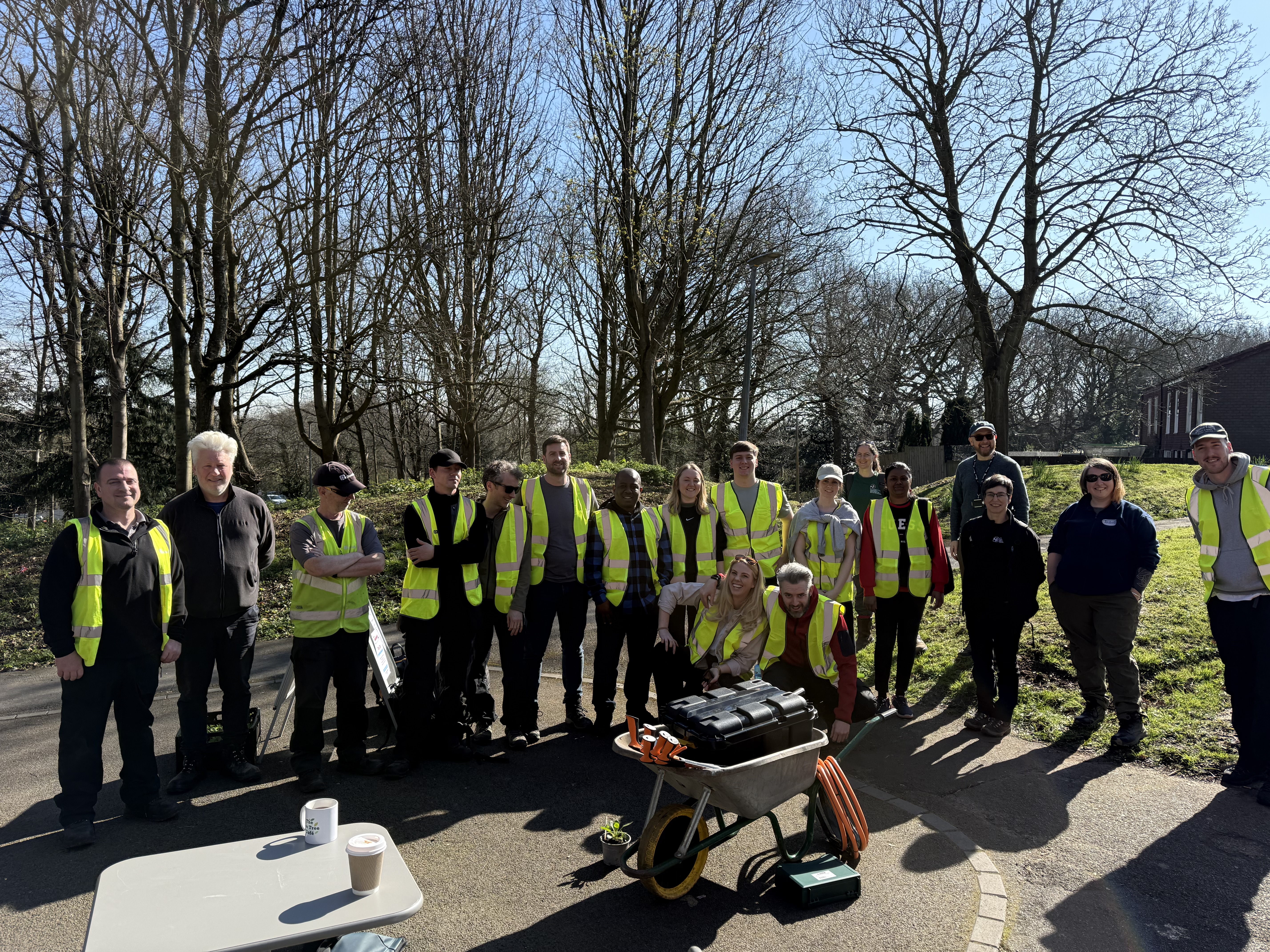
We are also taking action to support nature recovery and biodiversity. As part of our Green Spaces Plan, we delivered nature-based projects across communal spaces, neighbourhoods and Care and Support schemes, including tree planting, pollinator habitats, wildflower areas, food-growing spaces and sustainable drainage features. Our Ecology and Biodiversity procedure supports Biodiversity Net Gain requirements for new developments and helps ensure environmental benefits are considered across our existing communities and future investment plans.
Sustainability is increasingly embedded within our procurement and operational practices. We continue to strengthen environmental requirements within our supply chain, supported by sustainability questions, measures and performance indicators in procurement processes. Our ISO 14001-certified Environmental Management System helps us identify and manage environmental risks, while our Waste Management and Water and Wastewater Management procedures support responsible use of resources, pollution prevention and compliance with environmental regulations.
Social
Our BFT strategy identifies our committed to ensuring diverse customer voices help to influence our decisions and shape service delivery and use better data to identify inequalities and provide accessible, tailored services.
In 2025/26, Riverside's charitable Foundation continued to invest in projects, helping customers build financial resilience, sustain their tenancies and remain connected to their communities. Through Foundation-funded services, alongside support delivered by operational teams and partner organisations, we provided practical help to thousands of customers facing financial hardship, rising living costs and other challenges.
Our Money Advice Team received almost 5,000 referrals during the year and helped customers secure more than £4m in additional benefits, including over £1m in housing-related support paid directly to rent accounts. The Affordability Team supported around 400 new tenants, helping with access to furniture grants worth around £40,000, and securing more than £500,000 in benefit entitlement, helping customers settle successfully into their new homes. Riverside's Affordable Warmth Team also received almost 1,400 referrals and secured £112,000 through external grants and trust funds, alongside energy voucher support for households experiencing fuel poverty.
Riverside's Helping Hand Fund continued to provide emergency assistance to customers facing crisis or significant financial hardship. During 2025/26, more than 3,500 awards worth over £500,000 were made, including almost 1,400 food vouchers, energy support and essential household items. Our Housing Sustainment Service supported 569 customers with complex needs, with more than 95% of those successfully sustaining their tenancy.
We also continued to invest in customer wellbeing, employment and digital inclusion. Our Employment and Training Team supported 948 people, helping secure 227 job starts and supporting 157 customers into training. The Digital Inclusion programme supported 651 residents to access online services and improve their digital confidence, while our Health and Wellbeing Programme funded 60 activities benefiting more than 1,400 customers living in our retirement living services.
Providing safe, good-quality homes remains a key priority. During the year we strengthened our approach to damp and mould through improved inspection processes, enhanced quality assurance arrangements and the development of a new ventilation standard. We also continued preparations for Awaab's Law phase 1 and 2 by reviewing processes, strengthening oversight and ensuring colleagues are equipped to meet the new requirements. More than 99% of our homes continue to meet the Decent Homes Standard.
Listening to customers and acting on their feedback remains at the heart of our approach. During 2025/26 we implemented our new Customer Influence and Accountability Framework, providing clearer routes for customers to influence decisions, scrutinise performance and hold management to account. More than 3,000 customers took part in engagement and consultation activities during the year, resulting in over 200 recommendations that helped shape service improvements across the organisation. We also continued to deliver social value through our supply chain, securing over £100,000 for community projects, creating employment and training opportunities, and supporting local initiatives that strengthen communities and improve wellbeing.
Governance
We are pleased to have retained our G1/V2 regulatory grading following the Regulator of Social Housing's stability check in December 2025. Our Group Board and its committees maintain oversight of a comprehensive strategic risk register, ensuring clear links between risks, mitigations and assurance. ESG considerations are embedded throughout our governance framework, including risks relating to climate change, the quality of homes, decarbonisation, supply chain resilience and the increasing impacts of extreme weather events.
Our BFT strategy identifies equality, diversity and inclusion (EDI) as a cross-cutting theme, it remains central to Riverside’s approach. Through our EDI Policy, and the commitments set out in our five-year strategy, we continue to promote inclusive leadership, support diverse recruitment and succession planning, and create opportunities for customers and colleagues to influence decision-making. We remain committed to the National Housing Federation's Chairs' Challenge and continue to strengthen diversity across our governance community.
Customer voice plays a vital role in shaping Riverside's governance and accountability. During 2025/26, we implemented our new Customer Influence and Accountability Framework, providing clearer routes for customers to influence decisions, scrutinise performance and hold management to account. More than 3,000 customers participated in engagement and consultation activities, helping to shape service improvements across the organisation.
Our colleagues are critical to our success, and we remain committed to creating an inclusive, supportive and high-performing workplace. Our People Experience Team leads a broad wellbeing offer, supported by colleague networks, wellbeing champions, peer support groups and an Employee Assistance Programme. We continue to invest in professional development through apprenticeships, sponsored qualifications and professional memberships, helping colleagues develop the skills needed to support our customers and communities.
We are committed to delivering social value that strengthens communities and supports economic prosperity, wellbeing and independence. Through our supply chain and procurement activities, we have secured investment for community projects, volunteering opportunities, employment and training support, and digital inclusion initiatives, helping to create lasting positive impact in the neighbourhoods we serve.
Environmental sustainability is increasingly embedded within our procurement and operational practices. We continue to strengthen sustainability requirements across our supply chain through tailored tender questions, sustainability measures and performance indicators, ensuring a proportionate approach for suppliers of different sizes and sectors. Alongside our ISO 14001-certified Environmental Management System, these measures help us manage environmental risks, improve data collection and support progress towards our long-term net zero ambitions.
Governance of climate resilience also continues to evolve. During the year, we worked with the UK Health Security Agency on climate risk mapping to better understand flooding, overheating, cold exposure and air quality risks across our communities. This evidence will help inform future investment decisions and strengthen our approach to protecting customers, homes and neighbourhoods from the impacts of climate change.
SRS Standards Table 2025/26
2025/26 update (with comparison to last two year’s figures, where relevant)
Environmental
Climate Change
C1. Distribution of EPC ratings of existing homes (those completed before the last financial year).
| 2023/24 | 2024/25 | 2025/26 (SDR aligned) |
EPC A | 0.11% | 0.16% | 0.16% |
EPC B | 14.92% | 16.12% | 14.75% |
EPC C | 35.39% | 38.35% | 39.67% |
EPC D | 16.19% | 17.83% | 17.00% |
EPC E | 2.25% | 2.55% | 1.90% |
EPC F | 0.19% | 0.22% | 0.20% |
EPC G | 0.04% | 0.04% | 0.03% |
No EPC | 30.91% | N/A | |
EPC not known | 11.20% | 0.01% | |
EPC not required | 13.54% | 26.28% |
Figures taken from the Statistical Data Return (SDR) submitted to the Regulator of Social Housing for England.
C2. Distribution of EPC ratings of new homes (those completed in the last financial year).
| 2023/24 | 2024/25 | 2025/26 |
EPC A | 4.02% | 4.50% | 1.49% |
EPC B | 95.98% | 94.69% | 94.29% |
EPC C | 0.00% | 0.08% | 4.22% |
EPC D | 0.00% | 0.00% | 0.00% |
EPC E | 0.00% | 0.00% | 0.00% |
EPC F | 0.00% | 0.00% | 0.00% |
EPC G | 0.00% | 0.00% | 0.00% |
No EPC | 0.00% | 0.00% | 0.00% |
Figures taken from the Statistical Data Return (SDR) submitted to the Regulator of Social Housing for England.
C3. Does the housing provider have a Net Zero target and strategy? If so, what is it and when does the housing provider intend to be Net Zero by?
During 2025/26, Riverside continued to develop its strategic, costed retrofit roadmap, aligning EPC C compliance, emerging Minimum Energy Efficiency Standards (MEES) requirements and our long-term pathway to net zero carbon by 2050.
Riverside has a long-term ambition to achieve net zero carbon across its homes by 2050 and continued to develop this approach during 2025/26 through the creation of a strategic, costed retrofit roadmap. The roadmap aligns our immediate objective of achieving EPC C and meeting emerging Minimum Energy Efficiency Standards (MEES) requirements with our longer-term decarbonisation ambitions, ensuring that investment made today supports the transition to net zero in the future.
The roadmap establishes a phased pathway to 2030, 2039 and ultimately 2050, recognising that improving energy efficiency, reducing heat demand and tackling cold homes are the foundations of a successful net zero programme. It also prepares Riverside for the next stage of retrofit activity, including the wider deployment of low-carbon technologies such as heat pumps, solar PV, and battery storage as future MEES requirements evolve beyond fabric performance alone.
During 2025/26, work focused on developing the evidence base, investment modelling and delivery strategy needed to support this transition, ensuring that future programmes deliver warmer, healthier and more affordable homes for residents while creating a credible and financially sustainable pathway towards net zero carbon by 2050.
C4. What retrofit activities has the housing provider undertaken in the last 12 months in relation to its housing stock? How do these activities align with, and contribute towards, performance against the housing provider's Net Zero strategy and target?
Properties are having either External Wall Installation (EWI) or Cavity Wall Installation (CWI) installed to improve the thermal values of the dwelling. Additional elements such as insulated loft hatch and insulation top up, windows and doors replacements, roof replacement, both pitched and insulated flat roof, Swithchee smart thermostat installation as required. All properties are having ventilation improvements with door under cuts and continuous extract ventilation fans installed to kitchens, bathrooms, and separate WCs were required.
Number of Homes achieving EPC C as part of the Warm Homes: Social Housing Fund (WH:SHF) Wave 3 – Year 1:
Area | Number |
Halton | 113 |
Liverpool | 186 |
Langley | 24 |
Carlisle | 171 |
London | 90 |
Total | 584 |
These measures are helping to create healthier, warmer , and more energy-efficient homes for our customers.
WH:SHF Wave 3 will continue across the next two years, with the plan to improve the EPC to band C to 3,064 homes. This next phase will continue to improve energy efficiency, air quality, warmth and comfort, to our customers’ homes, along with a total of 500 homes receiving electrical heating upgrades and 305 homes being changed from gas to electrical heating and domestic hot water. These will be achieved by introducing low-carbon heating solutions, such as Air 2 Air, Air Source Heat Pumps, Ground Source Heat Pumps/ Networks, where suitable.
C5. Scope 1, Scope 2 and Scope 3 Green House Gas emissions per home. If unable to report emissions data, please state when the housing provider is expected to be able to do so.
Green House Gas emissions per home (tonnes CO2 emission (tCO2e)
Scope 1 & 2 | ||
23/24 | 24/25 | 25/26 |
21,509 | 20,743 | 18,643 |
Scope 1, 2 & 3 | ||
23/24 | 24/25 | 25/26 |
174,780 | 164,679 | 177,124 |
Scope 3 | ||
23/24 | 24/25 | 25/26 |
153,271 | 143,936 | 158,481 |
Scope 1, 2, & 3 carbon intensity per full-time employee | ||
23/24 | 24/25 | 25/26 |
41.6 | 38.4 | 47 |
Scope 1, 2, & 3 carbon intensity per property
| ||
23/24
| 24/25
| 25/26
|
2.8 | 3 | 2 |
Scope | New homes development | Existing homes and neighbourhoods (including managed properties) | Operations and corporate services |
Scope 1 Direct emissions from Riverside Group | No categories measured | Communal gas supply* | Offices ad hubs gas supply* Maintenance fleet* |
Scope 2 Indirect emissions from Riverside Group | No categories measured | Communal gas supply* | Offices ad hubs electric supply* |
Scope 3 Indirect emissions from Riverside Group and downstream activities from Riverside Group | No categories measured | Property emissions** | Business travel – private vehicle* Business travel – rail* Business travel – air* Staff commuting** Water usage and wastewater** |
(*measured and **partly measured)
Scope 1 and 2 emissions reduced by 10% during 2025/26, exceeding t2% reduction target. This reflects the rationalisation of offices and hubs, a pilot of electric vehicles and the continued decarbonisation of the national electricity grid.
Scope 3 emissions increased during the year, due to improvements in data quality rather than a deterioration in performance. Property emissions are calculated using SAP 10, external verification of Scope 1 and 2 emissions has been completed, with the expanded Scope 3 dataset to be validated during 2026/27.
C4. What retrofit activities has the housing provider undertaken in the last 12 months in relation to its housing stock? How do these activities align with, and contribute towards, performance against the housing provider's Net Zero strategy and target?
Properties are having either External Wall Installation (EWI) or Cavity Wall Installation (CWI) installed to improve the thermal values of the dwelling. Additional elements such as insulated loft hatch and insulation top up, windows and doors replacements, roof replacement, both pitched and insulated flat roof, Swithchee smart thermostat installation as required. All properties are having ventilation improvements with door under cuts and continuous extract ventilation fans installed to kitchens, bathrooms, and separate WCs were required. Number of Homes achieving EPC C as part of the Warm Homes: Social Housing Fund (WH:SHF) Wave 3 – Year 1:
These measures are helping to create healthier, warmer and more energy-efficient homes for our customers. |
C5. Scope 1, Scope 2 and Scope 3 Green House Gas emissions Scope 1, Scope 2 and Scope 3 Green House Gas emissions per home
If unable to report emissions data, please state when the housing provider is expected to be able to do so.
Green House Gas emissions per home (tonnes CO2 emission (tCO2e) | ||||||||||||||
Scope 1 & 2 | Scope 1, 2 & 3 | Scope 3 | Scope 1, 2, & 3 carbon intensity per full-time employee | Scope 1, 2, & 3 carbon intensity per property
| ||||||||||
23/24 | 24/25 | 25/26 | 23/24 | 24/25 | 25/26 | 23/24 | 24/25 | 25/26 | 23/24 | 24/25 | 25/26 | 23/24
| 24/25
| 25/26
|
21,509 | 20,743 | 18,643 | 174,780 | 164,679 | 177,124 | 153,271 | 143,936 | 158,481 | 41.6 | 38.4 | 47 | 2.8 | 3 | 2 |
Scope | New homes development | Existing homes and neighbourhoods (including managed properties) | Operations and corporate services |
Scope 1 Direct emissions from Riverside Group | No categories measured | Communal gas supply* | Offices ad hubs gas supply* Maintenance fleet* |
Scope 2 Indirect emissions from Riverside Group | No categories measured | Communal gas supply* | Offices ad hubs electric supply* |
Scope 3 Indirect emissions from Riverside Group and downstream activities from Riverside Group | No categories measured | Property emissions** | Business travel – private vehicle* Business travel – rail* Business travel – air* Staff commuting** Water usage and wastewater** |
(*measured and **partly measured)
Scope 1 and 2 emissions reduced by 10% during 2025/26, exceeding t2% reduction target. This reflects the rationalisation of offices and hubs, a pilot of electric vehicles and the continued decarbonisation of the national electricity grid.
Scope 3 emissions increased during the year, due to improvements in data quality rather than a deterioration in performance. Property emissions are calculated using SAP 10, external verification of Scope 1 and 2 emissions has been completed, with the expanded Scope 3 dataset to be validated during 2026/27.
C6. How has the housing provider mapped and assessed the climate risks to its homes and supply chain, such as increased flood, drought and overheating risks?
How is the housing provider mitigating these risks?
Riverside’s Climate Risk and Resilience Measures
In collaboration with the UK Health Security Agency, Riverside undertook a climate risk mapping exercise for properties in the Liverpool City Region at neighbourhood level, environmental and deprivation information to understand both Riverside homes and Riverside customer's exposure and vulnerability to:
- heat stress, overheating and the urban heat-island effect
- fluvial, coastal and pluvial flooding
- exposure to cold
- air quality.
The study also mapped Blue-Green Infrastructure related to tree canopy coverage, surface permeability and community access to green and blue infrastructure.
This study pilot is a proof of concept intended to produce a consistent and scalable climate-vulnerability mapping methodology that Riverside can implement across its portfolio to help identify homes, neighbourhoods and Care and Support schemes facing the greatest combined climate and health risks. The areas identified as being at the highest risk can be prioritised for the implementation of appropriate climate resilience measures in the future.
This information supports informed discussions with Riverside's insurers and underwriters, enabling all parties to develop a stronger understanding of the climate-related risks affecting the organisation's portfolio.
Flood Preparedness:
- A Flood Action Plan outlines prevention, response, and recovery protocols for flood incidents affecting Riverside properties.
- Nature-based flood solutions have been integrated into green spaces to manage water runoff and heavy rainfall.
- Future focus includes localised flood risks and heat stress in collaboration with insurance partners.
Riverside is integrating climate-related supply chain risks into its wider climate governance, procurement and sustainability frameworks. Climate-related supply chain risk is recognised within Riverside's climate risk management processes, including consideration of supply chain capacity, competency and resilience. We assess supply chain risks through sustainability requirements in procurement exercises, supplier due diligence, collection of supplier sustainability and carbon emissions data, and ongoing contract performance monitoring. Mitigation measures include sustainability-focused procurement criteria, and the promotion of low-carbon, responsibly sourced goods and services. Riverside is also expanding Scope 3 emissions data collection to improve understanding of supply chain impacts and support future risk management and decarbonisation activity.
C7. Has the housing provider mapped and assessed the increased water stress risks to its homes caused by climate change in the last 2 years?
How is the housing provider mitigating these risks?
Currently water stress has not been assessed. We have piloted rainwater harvesting and water attenuation, and water filtration as proof of concepts at a number of sites.
Riverside is working with a water company at assessment stage for four sites to implement rainwater harvesting/ water efficient pilots for Sustainable Urban Drainage supporting ‘Sponge Cities’ concept to assist mitigating, flooding, water discharge, and water stress.
C8. Has the housing provider mapped and assessed the increased overheating risks to its homes caused by climate change in the last 2 years?
How is the housing provider mitigating these risks?
As per response to C6.
Ecology
C9. Does the housing provider have a strategy to enhance green space and promote biodiversity on or near homes?
If yes, please describe with reference to targets in this area. If no, are you planning on producing one in the next 12 months?
Riverside has an Ecology and Biodiversity procedure which sets out the process for existing sites and new developments, including Biodiversity Net Gain. We encourage biodiversity on all our development sites and existing neighbourhoods, working in partnership with our customers.
Our new development teams have worked with partners to ensure Biodiversity Net Gain legislation has been implemented and deliver a minimum 10% where required.
The Riverside Green Spaces Plan 2025-27 shaped delivery of nature-based initiatives on existing neighbourhoods to support nature recovery, climate resilience, health and wellbeing. Riverside has been utilising greenspaces applying a “pilot, prove and scale” approach, using evidence from local projects to develop interventions that could be replicated across different regions and types of land.
Green-space pilots have been delivered across thirty-one communal-land sites, five Care & Support (C&S) schemes and four neighbourhoods. Interventions included tree and hedgerow planting, pollinator habitats, wildflower areas, food-growing spaces, raised planters, habitat features, sustainable drainage planters, attenuation planters, and ponds.
Over the next four years we plan to continue to plant a minimum of 210 standard trees across all regions in partnership with local community forest, adding woodland where possible to mitigate flooding.
These interventions are designed to:
- increase shade and contribute to local cooling
- improve rainwater capture and stormwater management
- increase surface permeability
- strengthen biodiversity and ecological connectivity
- improve access to nature; and
- support customers’ health, wellbeing and community connection.
Delivery has been supported through customer co-design consultation, external partnerships and environmental data.
Riverside is a Liverpool City Region (LCR) Local Nature Recovery Strategy Delivery Partner (read more about this here: Local Nature Recovery Strategy | Liverpool City Region Combined Authority), working with organisations including local authorities, Natural England, Utilities and the Wildlife Trust to identify opportunities, improve delivery standards and attract external investment. The plan’s initiatives will inform targets for future nature-based initiatives.
C10. Does the housing provider have a strategy to identify, manage and reduce pollutants that could cause material harm?
If so, how does the housing provider target and measure performance?
Riverside maintains an Environmental Management System (EMS) certified to ISO 14001, which provides a structured framework to identify, assess, manage and reduce environmental impacts, including pollutants that could cause material environmental harm. The EMS includes an environmental aspects and impacts assessment process to identify significant pollution risks associated with our activities, services, assets and supply chain. Appropriate controls, legal compliance obligations, monitoring arrangements and improvement actions are implemented to prevent pollution and minimise adverse environmental effects. Environmental risks, incidents and performance are reviewed regularly, and environmental objectives are established to drive continual improvement and reduce environmental impacts over time.
Performance is measured through Riverside's ISO 14001 Environmental Management System, including environmental aspects and impacts assessments, compliance monitoring, incident reporting, internal and external audits, and regular review of environmental objectives. Progress is reported through Riverside's governance framework and annual ESG and SECR disclosures, supporting continual improvement and pollution prevention.
Resource Management
C11. Does the housing provider have a strategy to use or increase the use of responsibly sourced materials for all building and repairs works?
If so, how does the housing provider target and measure performance?
We do not currently have a strategy in place; however, we work to requirements that ensure all materials for new build homes are sourced from responsible and traceable suppliers.
As part of the new procurement regulations, Riverside is including sustainability metrics within all our strategic contracts.
C12. Does the housing provider have a strategy for waste management incorporating building materials?
If so, how does the housing provider target and measure performance?
Riverside is fully committed to reducing its impact upon the environment by managing its waste streams in an effective and sustainable manner. We have a Waste Management Procedure in place to support this, setting out our duties to ensure waste is disposed of responsibly and using approved, registered waste contractors.
The procedure states that Riverside will adopt the ‘best practicable environmental option’ in the delivery of its waste management practices. Riverside will also apply a ‘waste hierarchical approach,’ to reduce, re-use, recycle and compost, recover, create energy (where applicable/ possible) from waste products in preference to the disposal of waste to landfill.
There is a legal requirement for all who produce, keep, or dispose of any waste of any type to comply with the various regulations and the Duty of Care under the Environmental Protection legislation. Riverside recognises the importance of meeting these legal requirements and to manage its waste responsibly, reduce the volume of waste sent to landfill and maximise re-use and recycling where possible. We require all colleagues and contractors to comply with this procedure and encourages customers and anyone else making use of our premises to comply.
Waste management performance of our organisational headquarters and other buildings where Riverside are directly responsible for contracting waste disposal is assured using four Key Performance Indicators (KPIs) within Riverside, which are total tonnes of waste: generated, recycled, recovered (i.e., energy from waste), and sent to landfill.
For Riverside-generated waste, where waste performance data is available it is collated centrally by the Sustainability Team, using information provided by our waste suppliers.
C13. Does the housing provider have a strategy for water management?
If so, how does the housing provider target and measure performance?
Riverside has a Water and Wastewater Management Procedure in place with the purpose of setting out how to manage site discharges and drainage and the various requirements for surface water and foul water discharge consents and water abstraction. This procedure also highlights the need for efficient use of water. Wastewater samples are taken periodically to ensure compliance and any non-compliance is recorded and investigated as an environmental incident.
C14. How is sustainability considered when procuring goods and services?
What measures are in place to monitor the sustainability of the housing provider’s supply chain when procuring goods and services?
Riverside is committed to driving positive environmental impacts in our supply chain through our procurement process. In the procurement process we require all suppliers, regardless of size or sector, to answer specify sustainability questions which contribute to the procurement assessment processes. To ensure proportionality and fairness we have tailored approaches our Procurement Team can use when putting the tender together. We have created a list of various sustainability requirements, questions and KPIs. Tender questions are divided into those most appropriate for a) Asset Services, b) Business Services and c) IT/ Data Services, they are also segmented into larger suppliers/ higher value contracts and smaller suppliers/ lower value contracts. We are working to establish robust methodologies to quantify the emissions associated with our supply chains.
Social
Affordability and Security
C15. For properties that are subject to the rent regulation regime, report against ONE or BOTH the following Affordability Metrics:
1) Rent compared to average private rental sector (PRS) rent across the relevant Local Authority
2) Rent compared to the relevant Local Housing Allowance (LHA)
% Riverside rents lower than LHA | % Riverside rents lower than PRS | ||||
23/24 | 24/25 | 25/26 | 23/24 | 24/25 | 25/26 |
42% | 27% | 29% | 85% | 60% | 53% |
*It is important to note that we operate nationally across 159 local authority areas. The chart below shows how our rents and service charges combined compare by region with LHA and PRS rents.
C16. Share, and number, of existing homes (owned and/or managed) completed before the last financial year allocated to:
- General needs (social rent)
- Intermediate rent
- Affordable rent
- Supported Housing
- Housing for older people
- Low-cost home ownership
- Care homes
- Private Rented Sector
- Other
Tenure of existing homes | Number of homes* | Percentage | ||||
23/24 | 24/25** | 25/26 | 23/24 | 24/25 | 25/26 | |
General Needs | 31,842 | 39,082 | 38,540 | 52.7% | 54.9% | 53% |
Intermediate Rent | 268 | 784 | 810 | 0.4% | 1.0% | 1.1% |
Affordable Rent | 8,942 | 10,787 | 10,790 | 14.8% | 14.3% | 14.8% |
Supported / Housing for Older People | 9,535 | 10,437 | 10,472 | 15.8% | 13.8% | 14.4% |
Low-cost Home Ownership | 2,916 | 5,175 | 5,178 | 4.8% | 6.8% | 7.1% |
Care Homes | 346 | 235 | 543 | 0.6% | 0.3% | 0.8% |
Non-social Rent | 327 | 328 | 325 | 0.5% | 0.4% | 0.5% |
Leasehold | 6,194 | 6,341 | 6,050 | 10.3% | 8.4% | 8.3% |
Total | 60,370 | 73,169 | 72,708 | 100% | 100% | 100% |
*This figure is based on our Statistical Data Return submitted to the Regulator of Social Housing for England to enable year-on-year comparison. It does not include homes owned and/or managed by Riverside Scotland.
**Figures from the previous year in red have been changed as they did not reconcile to the reported total. The adjustments ensure the individual items now accurately add up to the total property count/ percentage, while maintaining the same overall number of properties.
C17. Share, and number, of new homes (owned and/or managed) that were completed in the last financial year, allocated to:
- General needs (social rent)
- Intermediate rent
- Affordable rent
- Supported Housing
- Housing for older people
- Low-cost home ownership
- Care homes
- Private Rented Sector
- Other
Tenure of new homes | Number of homes* | Percentage |
| |||
23/24 | 24/25 | 25/26 | 23/24 | 24/25 | 25/26 | |
General Needs | 7,236 | 33 | 161 | 55% | 5.3% | 38.15% |
Intermediate Rent | 432 | 79 | 26 | 3% | 12.7% | 6.16% |
Affordable Rent | 1,694 | 276 | 117 | 13% | 44.5% | 27.73% |
Supported / Housing for Older People | 1,184 | 63 | 5 | 9% | 10.2% | 1.18% |
Low-cost Home Ownership | 2,561 | 169 | 113 | 20% | 27.3% | 26.78% |
Total | 13,107 | 620 | 422 | 100% | 100% | 100% |
*Figures taken from the Statistical Data Return (SDR) to enable year-on-year comparison.
C18. How is the housing provider trying to reduce the effect of high energy costs on its residents?
The Affordable Warmth Team in Riverside provide advice and assistance to customers at risk of fuel poverty. Between April 2025 and the end of March 2026 the team received almost 1400 referrals. The team provide individual advice around energy efficiency and savings, helping with accessing external support in accessing trust funds and external grants. The team helped customers gain £112k in external awards. Working with HACT and with TORUS housing the team issued around £50k of energy vouchers to customers in hardship.
Riverside's Helping Hand fund supports customers in a crisis and in the last financial year we used that fund to issue £12k of energy vouchers to around 400 customers who were at risk of self-disconnection.
Building Safety and Quality
C19. Describe the condition of the housing provider's portfolio, with reference to:
% of homes for which all required gas safety checks have been carried out.
% of homes that meet national fire safety regulations (varies by nation – see guidance).
% of homes for which all required electrical safety checks have been carried out.
% of homes for which all required asbestos management surveys or re-inspections have been carried out.
% of homes for which all required legionella risk assessments have been carried out.
% of homes for which all required communal passenger lift safety checks have been carried out.
|
C20. What % of homes meet the national housing quality standard?
Of those which fail, what is the housing provider doing to address these failings?
% of Riverside homes meeting the Decent Homes Standard | ||
23/24 | 24/25 | 25/26 |
99.88% | 99.52% | 99.07% |
Those that do not meet the criteria are put into an investment programme with works completed for them to become 100% compliant within the financial year.
C21. How do you manage and mitigate the risk of emergency hazards, including damp and mould?
How do you reduce the likelihood of damp and mould hazards occurring?
Overall Customer Satisfaction:
- All Riverside Group (TRG) Customers: 63.6%
- TRG Low-Cost Rental Accommodation & Low-Cost Home Ownership Combined (TSM): 66.9%
- TRG Low-Cost Rental Accommodation (TSM): 69.5%
- TRG Low-Cost Home Ownership (TSM): 35.7%
- Riverside Scotland (ARC): 87.1%
Satisfaction data is collected as part of an ongoing perception survey with all TRG customers, with feedback for these figures collected each month from April-25 to Mar-26. For the ‘All TRG’ customer view of overall satisfaction 7,226 customers provided feedback which represents 9% of all customers. The survey is completed using a combination of telephone and online surveys based on a random stratified sample, results are weighted to reflect TRG’s overall population based on both tenure and geography.
Feedback from this and other transactional satisfaction surveys are used to drive improvement across TRG, the feedback provided by customers is monitored on an ongoing basis with proactive contact made with customers to address individual areas of dissatisfaction. More strategically satisfaction feedback is prominent across key performance indicators and performance dashboards across the Group, with feedback from customers used to design and implement improvement plans around key services. Satisfaction results are made visible to customers on our website with performance data shared as part of ongoing newsletters, an annual report to customers as well as specific TSM data being made available online to allow for customer scrutiny.
Resident Voice
C23. What arrangements are in place to enable residents to hold management to account for the provision of services?
Riverside operates a comprehensive Customer Influence and Accountability Framework which enables residents to influence decisions, scrutinise performance, challenge service delivery and hold management to account at local, operational, strategic and governance levels. The framework was co-designed with customers and implemented during 2025/26 to strengthen accountability, transparency and the visibility of customer influence. It provides clear routes for customer voice to flow from lived experience through customer groups, panels, governance forums and ultimately to Board.
The framework combines customer surveys, digital engagement, local community engagement, scrutiny activity, customer panels, the Tenants and Residents Influence Partnership (TRIP), customer committee members and Board engagement into a single structured system of influence and assurance. It was developed in response to customer feedback requesting clearer routes to influence decisions, evidence of impact and stronger accountability arrangements.
At the strategic level, the Tenants and Residents Influence Partnership (TRIP) provides customer leadership and challenge. TRIP receives customer insight and recommendations from across the framework, provides assurance that customer priorities are reflected in service improvement activity and can escalate issues directly to Committees and Board. The Chair of TRIP participates in governance arrangements and reports on customer priorities, recommendations and outcomes.
Customers also participate directly within formal governance structures. Riverside has customer membership on the Customer Experience Committee and customer involvement in Board and Committee activities, ensuring that customer perspectives form part of strategic decision-making and oversight. The Customer Experience Committee provides assurance to Board that Riverside is listening and responding to customer voice, using customer insight, complaints information, satisfaction measures and service performance information to challenge management and monitor improvement activity.
At the operational level, dedicated customer panels for Complaints, Repairs, Service Charges and Care & Support services enable customers to scrutinise performance, shape service design, review improvement plans and make recommendations directly to management. Panel recommendations are formally reported through governance routes to TRIP and Committees, with progress and outcomes tracked and reported back to customers through “You Said, We Did” reporting.
Local accountability is strengthened through Regional Hubs, Tenant and Resident Associations, tenant groups, community groups and local engagement activity. These provide opportunities for customers to raise local issues, influence neighbourhood priorities and ensure local concerns are escalated into wider organisational decision-making where appropriate.
Riverside also maintains a range of thematic and inclusive engagement routes, including digital engagement through iCommunity, consultation exercises, accessibility and communication groups and targeted engagement with under-represented customer groups. These arrangements ensure that a broad and diverse range of customer voices contribute to service design, policy development and performance monitoring.
During 2025/26, customer influence activity resulted in more than 200 formal recommendations, with customer challenge directly contributing to changes in repairs, complaints, digital accessibility, communications, procurement, planned works and service design. Over 3,000 customers participated in engagement and consultation activity during the year. These outcomes are reported through formal customer influence reporting and annual assurance processes, providing transparency regarding how customer feedback has influenced decisions and improvements.
Through these arrangements, Riverside provides residents with clear, structured and accountable mechanisms to influence services, challenge decisions, scrutinise performance and hold management to account for service delivery.
C24. Report ONE OR BOTH of the following quantitative metrics:
- % of Stage 1 and Stage 2 complaints responded to within target timeframes (varies by nation).
- Average time in working days to respond to Stage 1 and Stage 2 complaints.
How have reported complaints resulted in change of practice within the housing provider?
Riverside Scotland:
| Stage 1 | Stage 2 |
Percentage of complaints responded to on time: | 100% | 95.56% |
Average time (in working days) to respond to complaints: | 6.05 days | 15.23 days |
For Riverside Scotland, response targets are: Five working days for Stage 1 and up to 20 working days for stage 2 complaints, in line with The Scottish Public Service Ombudsman. On the average, the time to respond to complaints at stage 1, there was one complaint that sat open even though it had been responded to in time. There have been no cases taken on by the SPSO in Scotland in 2025/26.
Riverside Group (except for those in bold, which have already been reviewed and validated as part of the annual report review):
Stage 1 | Stage 2 | |
Percentage of complaints responded to on time: | 70.9% | 70.8% |
Average time (in days) to respond to complaints: | 20.3 days | 24.4 days |
Ombudsman maladministration rate: 72.8%
Ombudsman severe maladministration rate: 3.3%
The Housing Ombudsman Service (HOS) investigated 174 individual complaints throughout 25/26. We received:
- 11 severe maladministration determinations (9 separate cases with 11 outcomes)
- 136 maladministration determinations
- 96 service failures
- 1 Complaints Handling Failure Order in respect of our delays in logging a complaint after they had already prompted us to do so
- 48 No Maladministration
- 40 instances where it was found that we had offered reasonable redress across the 331 individual determinations made across the investigations.
C25. In the last 12 months, what additional support have you provided to your tenants?
Please include support across any of the following areas, as well as any other relevant services:
- Employment & training
- Wellbeing & mental health
- Vulnerable tenants
Our Affordability Team provide advice and assistance to applicants who have been offered a Riverside tenancy to ensure they have furniture and ensure they understand how to set up their new tenancy, including claiming any housing-related benefits. In 2025/26, the team had around 400 referrals and helped customers obtain grants for furniture with a value of around £40k. The team also helped customers to make benefit claims with a value of over £500k per year. The team have also led on a furnished tenancy pilot.
Our Helping Hand Fund can be accessed by all Riverside front-line workers to help customers who are facing a crisis and/ or significant financial hardship. The fund provides one-off assistance, for example: replacing a cooker; providing fuel top-up vouchers; interview clothing and other items. Over 3,525 awards to customers were made in 2025/26, which amounted to over £500k. This included almost 1,400 food shopping vouchers. The Helping Hand Fund also helps with furniture and white goods. The items will always be the most energy efficient models. Last year over 300 brand new white goods were ordered for customers.
Our Housing Sustainment Service supports customers who are struggling to sustain their tenancy due to mental health or other support needs. Last year the service supported 346 customers, helping them to remain in their homes. During 2025/26, 569 customers received support from Riverside’s Housing Sustainment Service, 349 completed their support during the year, 95.86% of customers sustained their tenancy following support
Our Employment and Training Team is made up of 5.2 officers and the Team Leader. The team helped 948 people, achieving 227 job starts, supported 157 people with training, and enable 11 people into volunteering.
Social value outcomes from 2025/26:
Service | Cost of service | Total number of customers supported 25/26 | Cash Gains (ROI – return on investment) | Social Value Outcomes (adjusted – definition below) with number of customers supported with this outcome 25/26 (Social Value in £ for each outcome)* | Social Value Total (£) (adjusted)* | SROI – Social Return on Investment* |
|---|---|---|---|---|---|---|
Affordability | £96,288 | 395 | £535,000 | Able to obtain advice locally – 247 customers (£2,304 each) | £569,081 | £1:£5.91 |
Affordable Warmth | £141,912 | 682 | £112,000 | Heat Household in Winter – 300 customers (£6,108 each) | £1,832,368 | £1:£12.91 |
Housing Sustainment Service | £386,215 | 349 | – | Able to obtain advice locally £804,086 – 349 customers (£2,304 each) | £3,936,998 | £1:£10.19 |
Employment & Training | £270,715 | 948 | – | Full-time employment £1,932,543 – 157 customers (£12,309 each) | £3,059,958 | £1:£11.30 |
Grand Total | £9,398,405 |
*Figures in these columns relate to the HACT Social Value Insight tool, which uses a Social Value Bank that has a number of outcomes under different themes.
Our Money Advice Team provide specialist benefit advice. This is a national, predominantly phone-based service. In 2025/26, the team received almost 5000 referrals. They helped customers claim over £4m of additional benefits. Over £1m of this was Housing Benefits, including Discretionary Housing Payments, which directly go to rent accounts to help sustain customers' tenancies.
The Digital Inclusion programme supported 651 residents (338 in Quarter 4) to access essential online services, alongside 821 additional hub-based sessions to extend reach and engagement. This activity led to 288 residents improving their digital confidence, helping increase independence and access to employment, financial inclusion, and wellbeing support. The programme strengthened community capacity through 35 Digital Champions, whilst building 17 strategic partnerships to scale delivery and share best practice. A total of £29,000 in external funding was leveraged to provide devices, connectivity, and training, directly supporting customers facing digital exclusion. Infrastructure and service integration continued to develop, with Get Connected Hubs expanding, and digital support embedded across income, employment, and support services, ensuring a coordinated and sustainable approach to inclusion.
The C&S Retirement Living Health and Wellbeing project provides a small pot of funding that is available to retirement living services to enable staff and customers to come together to plan and deliver activities to improve customer health and wellbeing and build capacity and confidence for customers to plan, deliver and manage more of their own activities. In 2025/26, the Health and Wellbeing Programme received 71 applications, of which 60 were awarded funding. The total amount of funding provided was over £12,000, which benefited 1460 customers.
In the same year, we also gave out funds totalling £1,350 to two C&S services for Home Starter Packs, which came from contractors as part of their social value pledges money to fund home starter packs for C&S customers. The money has been used to buy household items for customers moving into independent accommodation, such as white goods, furniture and other household items.
Resident Support
C26. In the last 12 months, what interventions has the housing provider made or enabled to foster stronger communities and places, considering both:
- Physical changes to shared spaces or public realm
- Events, activities, and signposting
Resident engagement: Consultation on Social Value has taken place to understand what activities the community would benefit from in the future. A “fun day” including face painting and a burger van brought the community together to discuss social value.
- In partnership with Vistry, we are introducing the “care dogs” scheme in September 2026.
- The local councillor is looking to work with Riverside to introduce a free health and wellbeing check in the community, we are awaiting a start date for this.
- Monthly Independent Tenant Advice surgeries.
- Monthly London Regeneration
Ssurgeries.
Physical Spaces: We provided private gardens to each of the 20 new houses in Calverley Close (regeneration phase 1), as well as a central shared play area, including several pieces of climbing equipment. There is also an additional smaller play area constructed, including table tennis tables. These areas provide new and welcoming spaces for our tenants to come together and have proven popular since occupation of this phase, in aAutumn 2025.
Placemaking
C27. How is social value creation considered when procuring goods and services?
What measures are in place to monitor the delivery of this Social Value?
In line with the National Procurement Policy Statement, there must be regard for social value within each of our procurement tenders. The social value question is weighted and the tenderers must indicate what activities they can support throughout the term of the contract. Riverside’s work in social value will align with the priorities of the Riverside Foundation, which are:
- prevent evictions and homelessness by proactively working with customers to sustain their tenancies
- support the livelihoods of our customers through projects that provide advice and support and build capacity for people to
- improve their own lives – going beyond the traditional landlord service
- promote community resilience and empowerment by supporting new and existing
- voluntary groups who are trying to make life better in our neighbourhoods.
We want a coordinated approach to social value that will bring maximum opportunities and benefits to our customers and communities to support their economic prosperity, health and wellbeing, and independence. This is in the form of donations for community projects, volunteering, employment and training opportunities, digital inclusion.
To ensure we can genuinely measure our social value activities and communicate this to our customers and stakeholders, we use a social value portal which is accessed by our internal teams as well as our supply chain, enabling us to monitor and update all activities achieved through the contracts. In the last financial year this has led to over £100k being donated to our community projects such as our Well Fed campaign through Can Cook, improving young person resilience with Commando Joes, job starter packs and home starter packs. The supply chain has carried out more than 100 volunteer hours including working on tree planting schemes and other activities to improve our communal areas. Ten people have been employed, seven customers have experienced work placements, and three apprenticeships have been secured. Social value takes different forms, and we have also had several laptops, SIM cards and coats donated to our veteran community, support with our community centres, day trips for our older customers and sponsorship for sports teams.
Governance
Structure and Board
C28. What is the housing provider's most recent regulatory grading/status?
Following a stability check, Riverside retained its G1 and V2 regulatory grading In December 2025 by the Regulator of Social Housing (RSH). The G1 rating is the highest governance rating and means that Riverside is fully compliant with its governance requirements.
We have retained our grading for viability at V2 – a compliant grade – in recognition that we have the financial capacity and strategy in place to deal with a reasonable range of adverse scenarios and meet our financial commitments. The V2 grading is also reflective of the significant investment we are making in our homes including fire remediation and the strong focus we are placing on maintaining the quality of our homes. Link to RSH website.
C29. Explain how the housing provider’s board manages ESG risks.
Are ESG risks incorporated in the housing provider’s risk register?\
The Groupwide strategic risk register is owned by Riverside’s Group Board and its committees. It is a standing item at every meeting of Board, Group Audit Committee and Customer Experience Committee. The risk register has a clear line of sight between risks, mitigations and board assurance.
ESG risks are identified and mitigated across the strategic risk register, including:
- Quality of homes: We are committed to preserving the long-term viability of our homes and the Corporate Plan for 2023-26 included £600m investment in planned maintenance and improvement. We recognise the national awareness and interest in social housing property conditions which means that any properties found to be in poor condition will not only result in a poor customer experience but could also provide significant reputational issues. For customers, the quality of the home is not just about the components but also shared spaces and the external environment. The importance of maintaining a tight grip on the quality of homes is highlighted in the RSH's 2022/23 review of consumer regulation. The Safety and Quality standard emphasises the importance of having robust stock condition data. The merger with OHG brought a portfolio of tall buildings - building condition is especially important in this environment where issues like leaks, utility outages and component failure (even if not caused by Riverside, for instance, by utility work nearby) can quickly escalate into a major incident with adverse impact on customer experience.
- Sustainability: Climate change is inherently uncertain and environmental standards, solutions and technology may change over time. We are committed to meeting our Carbon Zero responsibilities and our Climate Strategy 2022-26 set out how we will do this, balanced with the need to protect the business plan especially with concerns over value for money and deliverability of EPCC/net zero on some stock types.
- Cost and supply chain difficulties in meeting EPC Band C (2030) and Carbon Zero (2050): Achieving Carbon Zero and EPCC by 2030 could lead to financial challenges beyond those modelled in the business plan, especially where we are unable to secure Social Housing De-Carbonisation Funds and with certain archetypes which cannot be brought up to standard. Shortages in the supply chain could lead to difficulties as well as pressure on the business plan.
Increased incidence of climate events e.g. overheating or flooding: Climate change will make flooding and overheating more frequent leading to rising insurance costs, customer disruption and harm.
The strategic risk register also sets out how we are mitigating against these risks, including through:
- publication of Riverside’s Climate Strategy 2022-26 – setting out how the Group will retrofit existing stock as well as meeting tougher standards for new builds
. - flood risk contingency arrangements
. - emergency response plans in place to protect customers in the case of an adverse event such as flooding or overheating
. - grant funding for Carbon Zero.
Riverside has adopted our new five-year Corporate Strategy, ‘Brighter Future Together’ for 2026-31, where sustainability, and Equality, Diversity & Inclusion are cross-cutting themes underpinning all areas of activity.
C30. as the housing provider been subject to any adverse regulatory findings in the last 12 months (data protection breaches, bribery, money laundering, HSE breaches, etc.) that resulted in enforcement or other equivalent action?
No.
The Recruitment and Selection Policy commitscommit the Group to a recruitment process which is fair, consistent, and effective, ensuring equality of opportunity and compliance with legislation. Individuals will be recruited based on ability and merit. This will be measured using selection criteria which is objective and justifiable in relation to the role and does not inhibit applications.
Diversity and Inclusion are important to Riverside, and we have signed up to the National Housing Federation’s “Chairs’ Challenge” to create a vision to become more equal, diverse and inclusive, and prioritise diversity in succession planning. During 2023, the way in which Board vacancies were advertised was reviewed, with a view to attracting a more diverse range of customers, particularly from ethnic minority backgrounds. This was successful, with over 75% of applicants in 2024/25 for Group Board and Committee posts identifying as non-White British, following a targeted campaign including launch of a Board Trainee Programme which runs for two years, promoting diversity for future recruitment. In 2025/26 this figure was 31%.
In terms of recruitment to senior management positions, we operate a guaranteed interview scheme. This means that any applicants who identify as ethnically diverse and meet the minimum requirements for a post, are guaranteed an interview.
C31. How does the housing provider ensure it gets input from a diverse range of people into the governance processes?
The Group’s Equality Diversity and Inclusion Policy ensures that all people services and recruitment procedures reflect the Group’s principles including equality of opportunity to help maximise the potential of all current and potential colleagues and relevant procedures for board and committee members. The Group also collects, reviews, and measures data on a regular basis to inform us on ED&I performance and outcomes.
As of 31 March 2026:
- The Board was 67% female, and the wider governance community was 53% female.
- 25% of Board members identified as ethnically diverse, and the wider governance community was 23.3% ethnically diverse.
- No members of the Board had declared having a disability, and 11% of the wider governance community declared themselves to have a disability.
- The average age of the Board was 59 years, and 55 in the wider governance community.
- The average tenure of the board was 2.3 years.
- One member (8%) of the Board is a tenant member. In addition, there is a customer Observer at each Board meeting and a further seven tenant members on Committees of the Board and subsidiary Boards.
In addition, Riverside has recently revised its Customer Influence and Accountability Framework, introducing a seven-stage structure for customer voice to influence decision-making, including a new Tenants and Residents Influencing Partnership body whose meetings and scrutiny activity is reported up into the governance structure.
C32. Does the housing provider have policies that incorporate Equality, Diversity and Inclusion (EDI) into the recruitment and selection of board members and senior management?
How do they do this?
The Recruitment and Selection Policy commit the Group to a recruitment process which is fair, consistent, and effective, ensuring equality of opportunity and compliance with legislation. Individuals will be recruited based on ability and merit. This will be measured using selection criteria which is objective and justifiable in relation to the role and does not inhibit applications.
Diversity and Inclusion are important to Riverside, and we have signed up to the National Housing Federation’s “Chairs’ Challenge” to create a vision to become more equal, diverse and inclusive, and prioritise diversity in succession planning. During 2023, the way in which Board vacancies were advertised was reviewed, with a view to attracting a more diverse range of customers, particularly from ethnic minority backgrounds. This was successful, with over 75% of applicants in 2024/25 for Group Board and Committee posts identifying as non-White British, following a targeted campaign including launch of a Board Trainee Programme which runs for two years, promoting diversity for future recruitment. In 2025/26 this figure was 31%.
In terms of recruitment to senior management positions, we operate a guaranteed interview scheme. This means that any applicants who identify as ethnically diverse and meet the minimum requirements for a post, are guaranteed an interview.
C33. What % of the housing provider's Board have turned over in the last two years?
What % of the housing provider's Senior Management Team have turned over in the last two years?
- 25% of Riverside’s Board have turned over in the last two years.
- 43% of Riverside’s Senior Management Team have turned over in the last two years.
C34. Number of board members on the housing provider's Audit Committee with recent and relevant financial experience.
Four:
- The Board Chair is a Chartered Accountant (ACA) and retired Chief Financial Officer.
- One member is a Fellow of the Chartered Institute of Management Accountants (FCMA).
- One member is a Fellow of the Institute of Chartered Accountants and a member of the Chartered Institute of Internal Auditors.
One member is a CFO and Member of the Chartered Institute of Public Finance and Accountancy.
C35. What % of the housing provider's board are non-executive directors?
- 92% (unchanged from our 2025 ESG report).
C36. For how many years has the housing provider’s current external audit firm partner been responsible for auditing the accounts?
- Five years.
- The external audit will be undertaken by another provider from 2026/27.
C37. When was the last independently-run, board-effectiveness review?
- An externally supported effectiveness review was last undertaken in 2024, and an external review is scheduled to be completed during 2027.
- An externally supported governance review was undertaken in September 2025.
C38. How does the housing provider handle conflicts of interest at the board?
The Rules of the Association includes a section on Board Members’ interests, and the Governance Framework sets out Board Members responsibilities to act in the interests of the organisation. This is further embedded through the Board Members’ Code of Conduct, and all Board Members are provided with a copy of the Conflict of Interest ‘Decision Tree’ during their induction.
A Register of Interests is maintained and is presented to the Group Board annually. Members are expected to keep this up to date and changes are proactively sought during an annual review of information. The Board Member Register of Interests are publicly available via our website.
Declarations of Interest are included as a standing item at the start of every Board and Committee meeting.
Employees
C39. Does the housing provider pay the Real Living Wage?
Yes
C40. What is the housing provider's median gender pay gap?
- 10.70%* (a 1.09% decrease from the previous year).
- Our gender pay gap is not because of different rates of pay, but a high proportion of females in our lower quartile roles in Care & Support and a comparative under representation within our upper quartile roles. Please see the full 2025 report.
* The figure reported is based on payroll data as of the snapshot date of 5 April 2025.
C41. What is the housing provider's CEO:median-worker pay ratio?
CEO:median-worker pay ratio | |||
| 23/24 | 24/25 | 25/26 |
Median ratio (50th quartile) | 10.78 | 10.29 | 12.71 |
25th quartile | 12.53 | 11.75 | 11.01 |
75th quartile | 7.94 | 7.68 | 8.19 |
C42. How is the housing provider ensuring equality, diversity and inclusion (EDI) is promoted across its staff?
Equality, Diversity and Inclusion (EDI) is embedded within Riverside's culture and values. Through our refreshed Brighter Future Together Corporate Strategy, creating an inclusive, high-performing culture where colleagues can thrive is a key priority, supported by our organisational value, We Are Inclusive. Colleagues are encouraged to demonstrate Riverside's values in their everyday work and reflect on these as part of annual performance and development conversations.
We continue to support four colleague-led networks: EMpower (for ethnically diverse colleagues), Enable (for disabled colleagues and colleagues with health conditions), Pride (for LGBTQIA+ colleagues) and WREN (Women at Riverside Employee Network). Each network is supported by an Executive Sponsor, helping ensure colleague voices influence decision-making and organisational priorities. Membership is open to allies and colleagues can join more than one network, recognising the importance of intersectionality.
Our peer support groups across Riverside provide safe, confidential spaces where colleagues can connect, share experiences and support one another. Groups are available for colleagues with lived experience of cancer, parenting, bereavement, menopause, mental health challenges, long-term health conditions, neurodiversity and other life experiences, helping to foster a culture of belonging and inclusion. We also have colleague 'Family Friendly Buddies' who provide a peer support offer to help colleagues through flexible working considerations, parental leave, returning to work after life‑changing events, and supporting colleagues through all stages of family life. A directory of more than twenty colleagues across Riverside with various lived experience of parenthood who are happy to support fellow colleagues has also been developed.
All colleagues are required to complete a mandatory EDI e-learning module. The training includes practical examples of discrimination, unconscious bias and microaggressions to help colleagues understand the impact of behaviours and create more inclusive workplaces. Content is regularly reviewed to ensure it remains relevant, engaging and aligned with best practice.
We have a network of Wellbeing Champions who act as role models and advocates for inclusion across Riverside. All Champions are trained Mental Health First Aiders and work to raise awareness, promote positive workplace behaviours and help embed fairness, respect and inclusion throughout the organisation.
We are reviewing and strengthening our Equality Impact Assessment (EIA) framework to improve consistency, ensure assessments are completed at the earliest stages of policy and service development, and provide stronger assurance regarding the impact of decisions on different groups. A dedicated EDI resource has been strengthened through the introduction of an ED&I Assurance Coordinator role, responsible for supporting governance, assurance reporting, external commitments and the coordination of ED&I activity across Riverside.
EDI is also supported through dedicated expertise within People Services, including a People Experience Officer who has colleague health and wellbeing, engagement, and inclusion within their portfolio. We also have a Head of People Experience starting in November 2026, demonstrating that we have a dedicated team looking after the employee journey through a people experience lens.
We continue to monitor workforce diversity data, support inclusive recruitment and leadership pathways, and work towards our ambition of creating a workplace that better reflects the communities we serve. In terms of strengthening our EDI data, insight and assurance mechanisms, with an increasing focus on understanding outcomes, identifying disparities and using evidence to inform action. This includes improving diversity data quality, strengthening reporting and ensuring that assurance considers both quantitative and qualitative evidence. Our EDI commitment is reinforced through Brighter Future Together, which identifies Equality, Diversity and Inclusion as a cross-cutting theme and commits Riverside to building an inclusive workplace where every colleague feels valued, respected, and able to achieve their potential.
We are moving from a standalone EDI approach towards embedding equality, diversity and inclusion within corporate, customer, homes, people and governance strategies. This approach strengthens accountability by ensuring ED&I is owned and delivered through mainstream business planning, performance management and assurance processes.
C43. What activity has the housing provider undertaken over the last 12 months to support the physical and mental health of its staff?
What impact has this had on staff and the wider organisation?
Colleague health and wellbeing is a core part of our organisational approach and is supported through a broad, accessible offer for all colleagues. Our dedicated People Experience Team helps drive our wellbeing agenda, ensuring colleagues can access support whether they work on the frontline, in an office, or from home.
Our wellbeing offer brings together policies, guidance, support networks and practical resources to help colleagues look after their physical, mental and financial wellbeing. This includes policies and guidance covering workplace stress, health surveillance, reasonable adjustments, display screen equipment and specific health-related matters, such as fertility support.
We provide a range of colleague-led and organisational wellbeing support. This includes Wellbeing champions across the business who provide signposting and peer support, as well as colleague networks and groups focused on physical and mental wellbeing. These groups support colleagues through a range of life experiences, including cancer, bereavement, menopause and parenthood. Our EnNable colleague network group also supports colleagues with disabilities or long-term health conditions and promotes wellbeing across the organisation.
We actively encourage colleagues to look after their wider wellbeing and connection to community. All colleagues receive two volunteering days each year to support their community or a cause that matters to them. We also provide access to an Employee Assistance Programme, supported by AXA, and can offer additional financial assistance in times of need through our in-house charity, ‘Workplace Trust’, which is funded by colleague donations through their salary.
We listen to colleagues and use their feedback to inform our wellbeing priorities. Our annual colleague Our Riverside Voice survey includes dedicated health and wellbeing questions, with action plans developed in response to the findings. Colleagues can also access our Wellbeing Hub on our intranet, which brings together practical guidance and resources aligned to the five ways to wellbeing: 'Staying Connected', 'Staying Well', 'Lifelong Learning', Supporting Financial Wellbeing', and 'Giving Back'.
C44. What activity has the housing provider undertaken over the last 12 months to support the professional development of its staff?
What impact has this had on staff and the wider organisation?
We have two main routes for colleagues to access professional development qualifications and programmes; apprenticeship and professional sponsorship. Apprenticeships are fully funded work-based, pragmatic training courses that provide nationally recognised qualifications and certificates from entry to master's level. In 25/26 we had 87 colleagues completing apprenticeships.
Professional Sponsorship is for those formal qualifications that cannot be completed as an apprenticeship. For example, they may be niche or brand new to the sector. For requests outside our fully funded offering, colleagues can apply for a study grant of up to £1,500 per year for three years. In 2025/26 we had 48 colleagues completing the sponsored (commercial) route.
We meet subscription costs for colleagues who are members of relevant professional bodies.